The Default Mode Network: Why Your Mind Wanders
Have you ever sat down to focus, only to realize ten minutes later that you've drifted into memories, worries, or your phone — without consciously choosing to?
That experience isn't a lack of willpower.
It's your brain doing exactly what it evolved to do.
At the center of this behavior is a powerful system called the Default Mode Network — and understanding it changes how we think about focus, distraction, and modern digital life.
What Is the Default Mode Network?
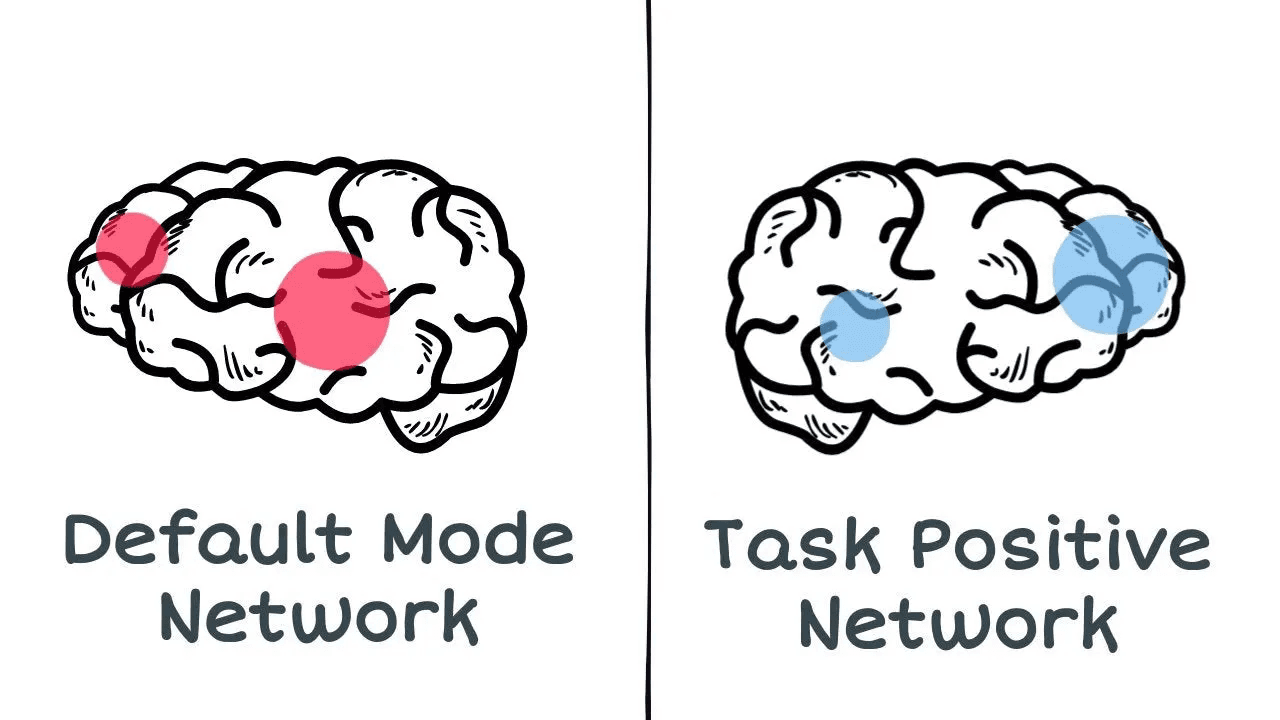
The Default Mode Network (DMN) is a group of interconnected brain regions that becomes most active when your attention turns inward.
It lights up when you're:
- Daydreaming
- Reflecting on yourself
- Thinking about the past or future
- Imagining conversations or outcomes
- Letting your mind wander
In other words, the DMN is what your brain defaults to when it's not fully engaged with the outside world.
This is not “idle” activity.
It's some of the brain's most complex work.
The DMN's Core Job: Building “You”
At its deepest level, the DMN maintains your sense of self.
It continuously constructs:
- Your identity (“This is who I am”)
- Your inner narrative (“This always happens to me”)
- Your values, goals, and fears
- The feeling that you are the same person over time
Without the DMN, experiences would feel disconnected — moments without meaning.
With it, your life becomes a story.
This is essential for learning, growth, and self-awareness.
Your Brain's Mental Time Machine
One of the DMN's most powerful functions is mental time travel.
It allows you to:
- Revisit the past (memories, regrets, successes)
- Simulate the future (plans, worries, imagined outcomes)
- Run “what if” scenarios on repeat
Importantly, the brain doesn't strongly distinguish between imagined experiences and real ones.
Emotionally, they can feel just as vivid.
That's why:
- Regret can linger for years
- Anxiety feels urgent even without immediate danger
- A future scenario can hijack your mood right now
Your brain is constantly simulating — not resting.
The Social Side of the DMN
Humans evolved in social groups, and the DMN plays a major role in social prediction.
It helps you:
- Interpret other people's intentions
- Replay conversations (I did it this week…)
- Anticipate judgment or rejection
- Evaluate your social standing
This is adaptive — it keeps you connected and safe.
But in a world of:
- Social media metrics
- Endless comparison
- Permanent digital visibility
The DMN can become overstimulated.
You don't just live your life — you mentally observe yourself living it.
Meaning-Making: Where Overthinking Is Born
The DMN doesn't just replay events.
It interprets them.
It asks:
- “Why did this happen?”
- “What does this say about me?”
- “What does this mean for my future?”
Two people can experience the same event and walk away with completely different emotional outcomes — purely based on the story their DMN tells.
This meaning-making ability fuels:
- Creativity
- Insight
- Motivation
But when it runs unchecked, it becomes:
- Rumination (stuck with negative thoughts)
- Self-criticism
- Mental noise
The DMN generates narratives — not necessarily truth.
The Push–Pull: DMN vs Focus
Your brain has another set of networks responsible for:
- Attention
- Problem-solving
- Sensory engagement
- Executive control
These task-positive networks and the DMN work in opposition — like a seesaw.
- Deep focus → DMN quiets down
- Distraction or idle moments → DMN ramps up
Here's the problem with modern life:
Constant notifications, short-form content, and quick checks prevent the DMN from ever fully settling — and prevent focus networks from fully engaging.
You end up stuck in a halfway state:
- Not focused enough to feel flow
- Not idle enough to feel rest
This is why distraction feels exhausting.
Phones and the DMN Loop
Phones are uniquely effective at triggering DMN activity:
- Brief interruptions break focus
- The mind immediately turns inward
- You check your phone again — often without intention
- The loop repeats
Over time, this trains the brain to:
- Seek stimulation at the first hint of mental discomfort
- Avoid sustained attention
- Default to mind-wandering more quickly
This isn't addiction in the traditional sense — it's a nervous system stuck in constant self-referential mode.
When the DMN Is Healthy — and When It's Not
A healthy DMN supports:
- Creativity and insight
- Long-term planning
- Empathy
- Self-understanding
An overactive DMN leads to:
- Rumination
- Anxiety
- Depression
- Chronic distraction
- Compulsive checking behaviors
The issue is not the DMN itself —
it's losing control over when it's active.
Understanding Comes First. Change Follows.
Lasting focus doesn't come from forcing yourself to resist distraction.
It comes from understanding why your mind drifts in the first place.
When you understand the Default Mode Network, distraction stops feeling like a personal failure — and starts looking like a predictable brain pattern that can be guided with intention.
This is where thoughtful boundaries matter.
Not as punishment, but as structure.
Not to fight your mind, but to support it.
By creating moments of uninterrupted attention, intentional pauses, and space for your mind to settle, you give your brain what it needs to move out of constant self-noise and back into presence.
Change doesn't begin with more effort.
It begins with awareness — and the right environment to let focus emerge naturally.